Dow jumps 592 points on Black Friday to cap its best week since 2022
Stocks rallied in Friday's half-day session, giving the Dow its biggest weekly gain since October 2022 after a volatile run for Nvidia, Anthropic and AI shares.
What happened
U.S. stocks rose across the board in the shortened Black Friday session on Nov. 27, 2026. The Dow Jones Industrial Average gained 591.99 points, or 1.2%, to 50,774.94, finishing its best week since October 2022. The S&P 500 climbed 1.6% to 7,297.49 and the Nasdaq composite rose 2.3% to 24,129.50, as beaten-down AI and chip stocks bounced back before the 1 p.m. ET close.
Key takeaways
- For the week, the S&P 500 gained 5.6%, its biggest weekly rise since April 2025, and the Nasdaq added 6.68%, Reuters reported.
- Anthropic jumped about 11% to $91.88, back above its $83 IPO price after briefly slipping below it on Wednesday.
- Even after the rebound, the S&P 500 and Nasdaq are on pace for their worst November since 2008, according to Reuters.
- The 10-year Treasury yield rose to 4.94% from 4.85% late Wednesday, the AP said, as traders bet on a December Fed rate hike.
In this article
Wall Street went bargain hunting on Black Friday. In a session that lasted only three and a half hours, every major U.S. index finished higher, and the Dow Jones Industrial Average locked in its best week since October 2022.
The Dow closed up 591.99 points, or 1.18%, at 50,774.94 when trading stopped at 1 p.m. ET. The S&P 500 gained 114.71 points, or 1.6%, to 7,297.49, and the Nasdaq composite rose 543.70 points, or 2.31%, to 24,129.50, according to Reuters.
The rally was broad. Roughly four of every five stocks in the S&P 500 rose, the Associated Press reported, and Kiplinger noted that all 11 stock market sectors ended in the green, with consumer discretionary shares out in front.
Read also: The Dow Jones surges 1,104 points as tech stocks rebound from a selloff · Dow erases a 1,100-point drop to close higher as Nvidia leads an AI stock selloff · Anthropic prices its IPO at $83 a share, valuing the Claude maker at $1.5 trillion
Dow's best week since 2022, by the numbers
All three benchmarks gained more than 5% over the four trading days. Reuters put the Dow's weekly rise at 5.46%, its largest since October 2022. The S&P 500 climbed 5.6%, its best week since April 2025, when President Donald Trump paused most of his "Liberation Day" tariffs. The Nasdaq did better still, up 6.68%.
Barron's said the three indexes just had their strongest Thanksgiving week since 2008.
That is a sharp reversal from a week ago. The S&P 500 ended last Friday more than 10% below the record it set in October, the AP said, which put it in what traders call a correction.
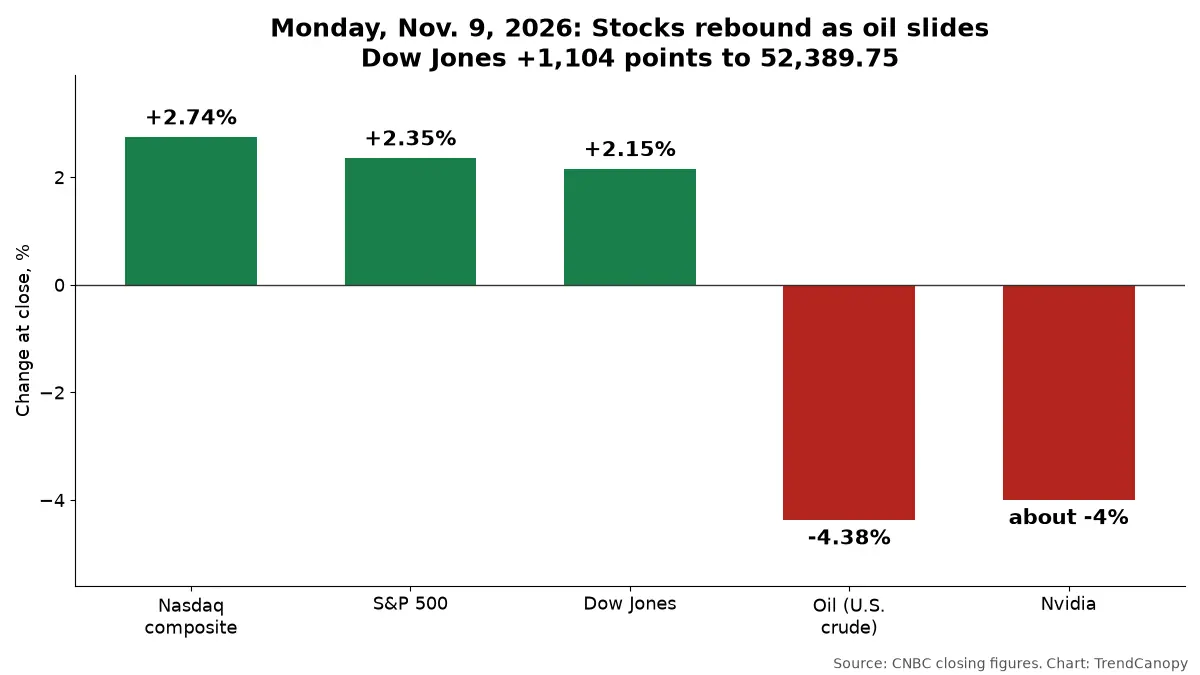
The path up was anything but smooth. Monday did most of the lifting, after Nvidia's board brought Jensen Huang back as CEO. Nvidia shares soared 31% that day and the Dow added more than 1,400 points, CNBC reported. We covered that move in Nvidia reinstates Jensen Huang as CEO, and the stock jumps more than 27%.
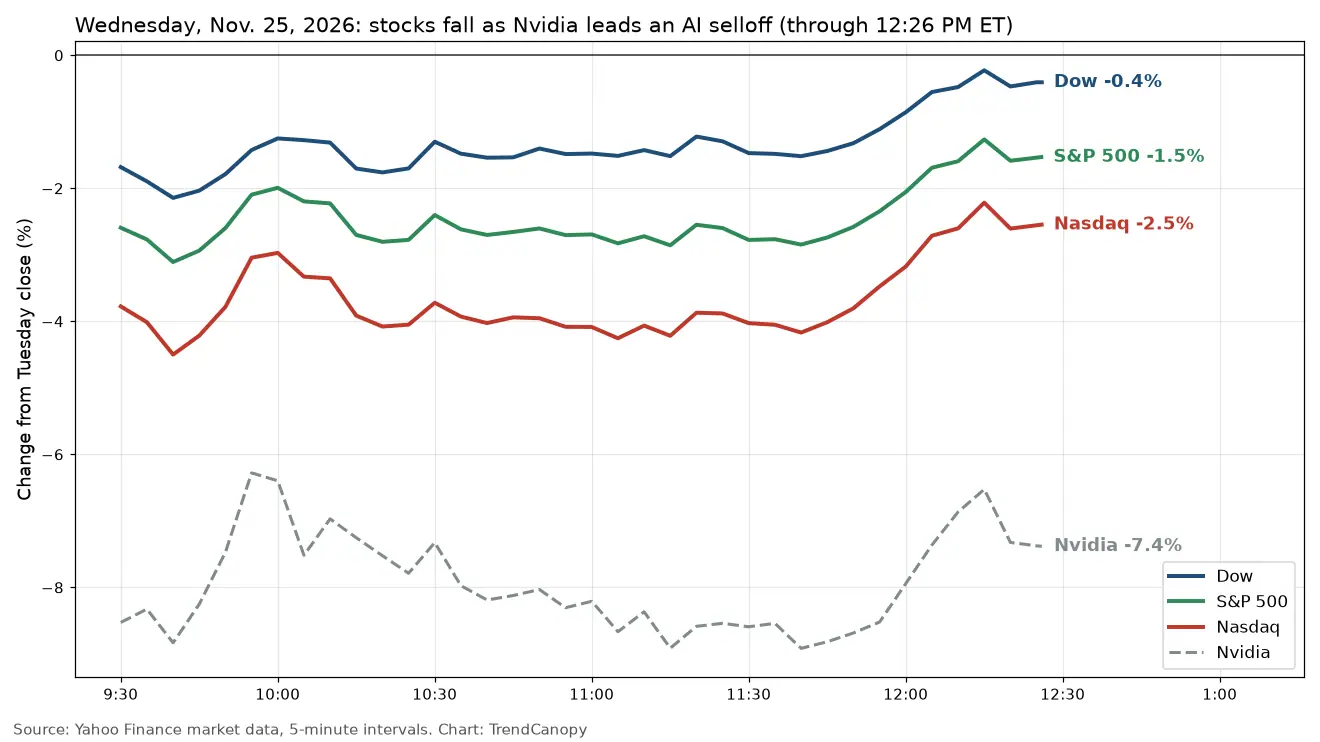
Tuesday and Wednesday were rougher. On Wednesday the Dow fell more than 1,100 points at its low before clawing all of it back, a swing we tracked in Dow erases a 1,100-point drop to close higher as Nvidia leads an AI stock selloff. Markets were shut Thursday for Thanksgiving.
Chip and AI stocks lead the Black Friday stock market rally
Friday's gains came mostly from the companies that had been hit hardest in November. The Philadelphia Semiconductor Index rose 4.7%, Reuters said. Micron gained 7.6% and Marvell 7.3%. Data-storage maker Sandisk surged almost 16%, and Dell and optical parts maker Lumentum also posted big moves.
Nvidia, oddly, lagged. It spent most of the morning in the red and finished up just 0.8%. Kiplinger described the chipmaker as ending in the middle of the pack among the 30 Dow stocks. Nvidia is still well above where it traded before Huang's return, but it has given back a large part of Monday's jump.
Broadcom rose 3.8%. Among the giant tech platforms, Meta gained more than 3% and Amazon about 4%, CNBC reported. Tesla climbed 5%. The AP tied Amazon's rise in part to the start of the holiday shopping season.
Retail stocks were mixed on the busiest shopping day of the year. Target slipped 0.1% and Macy's gained 1.2%, according to the AP. For the store side of the day, see Black Friday store hours start at 5 a.m. at Kohl's and JCPenney, while REI stays closed.
Banks joined in, too. The S&P 500 bank index rose 1.6%, helped by a gain of almost 2% in JPMorgan Chase.
Anthropic stock climbs back above its IPO price
Anthropic had the kind of week that makes new investors nervous. The Claude maker, the first major frontier AI lab to list its shares, briefly dropped below its $83 IPO price on Wednesday. On Friday it rose about 11% to $91.88.
That still leaves the stock well short of the $115 it touched on its first day of trading last week, the AP noted. Our earlier coverage of the listing is in Anthropic prices its IPO at $83 a share, valuing the Claude maker at $1.5 trillion.
Why investors bought this week
Some of it was simple math. After weeks of selling, many AI names looked cheap to traders who had sat out the drop. "The market is so oversold that a bounce was inevitable," Jamie Cox, managing partner at Harris Financial Group, told Reuters.
Andrew Slimmon, a senior portfolio manager at Morgan Stanley Investment Management, said hedge funds and other fast-moving traders had pulled so much money out of tech that they may be forced to buy back in. He told Reuters the bounce "could have persistence next week."
Not everyone reads it that way. CNBC reported that some strategists think the bigger force on stocks this fall has been the Federal Reserve, not AI. Traders now almost fully expect a rate hike in December, according to Reuters, after reports this week showed third-quarter growth was much faster than first estimated and inflation sped up in October. The numbers are in PCE inflation rises to 3.8% in October as summer GDP growth is revised up to 4.3%.
Bond yields moved with that view. The 10-year Treasury yield climbed to 4.94% from 4.85% late Wednesday, the AP said. Higher yields raise borrowing costs for mortgages and car loans, and they tend to weigh on richly priced growth stocks.
What the rally means for your 401(k)
A strong week doesn't erase a bad month. Reuters said the S&P 500 and Nasdaq are still headed for their worst November since 2008, weighed down by worries about tougher AI rules after Democrats' gains in the midterm elections and by the prospect of higher interest rates.
For anyone holding an S&P 500 index fund, this week's moves came largely from a small group of giant companies. Nvidia, Broadcom, Microsoft, Amazon and Meta are big enough that their swings decide much of what the whole index does, which is why AI headlines now show up so quickly in retirement accounts.
Trading was thin, as it usually is after Thanksgiving. Reuters counted 10.97 billion shares changing hands across U.S. exchanges, and light volume can exaggerate moves in either direction.
Stock market hours next week
U.S. stock markets reopen at their regular hours, 9:30 a.m. to 4 p.m. ET, on Monday, Nov. 30. That is also the last trading day of November, so it will settle how bad the month looks on paper.
The calendar after that is busy. Huang is due to testify before Congress next week, the New York Post reported on Tuesday, and the November jobs report follows, and the Fed's two-day meeting ends Dec. 9 with a rate decision that Wall Street now treats as nearly certain to go up. Any one of those could decide whether Friday's bounce carries into December or fades the way Monday's did.
Frequently asked questions
- Why is the stock market up today?
- Stocks rose Friday, Nov. 27, because investors bought back AI and chip shares that had been sold hard this month. The chip index gained 4.7%, Anthropic jumped 11% and Amazon rose about 4% as holiday shopping began. About four of every five stocks in the S&P 500 finished higher, the AP reported.
- Is the stock market open on Black Friday?
- Yes, but only for half a day. The NYSE and Nasdaq opened at 9:30 a.m. ET on Friday, Nov. 27, 2026, and closed early at 1 p.m. ET. Markets were closed Thursday for Thanksgiving and return to normal 9:30 a.m. to 4 p.m. hours on Monday, Nov. 30.
- How much did the Dow go up this week?
- The Dow Jones Industrial Average rose 5.46% for the holiday-shortened week ending Nov. 27, 2026, its largest weekly gain since October 2022, according to Reuters and CNBC. It closed Friday at 50,774.94. Monday did most of the work, when the Dow gained more than 1,400 points after Nvidia reinstated Jensen Huang.
- Did Anthropic stock go back above its IPO price?
- Yes. Anthropic shares rose about 11% on Friday to close at $91.88, above the $83 IPO price set last week, the AP reported. The stock had dipped below $83 on Wednesday during an AI selloff. It is still well under the $115 high it hit on its first day of trading.
Sources
- Stocks jump to close out an erratic week that was also Wall Street's best in more than a year · The Associated Press, Nov. 27, 2026
- Wall Street ends higher as battered AI stocks gain in volatile week · Reuters (via Investing.com), Nov. 27, 2026
- Dow rallies nearly 600 points to close out best week since 2022: Live updates · CNBC, Nov. 27, 2026
- Dow Adds 592 Points on Black Friday as AI Fear Fades: Stock Market Today · Kiplinger, Nov. 27, 2026
- Stocks Wrap Up Best Thanksgiving Week in Nearly 20 Years · Barron's, Nov. 27, 2026
About the author
Founder and editor
Marcia Reid is the founder and editor of TrendCanopy, where she reviews and edits every story.
Spotted an error? Read our corrections policy or contact us. Last reviewed November 27, 2026.
Related stories

Trending now
News ·
Andrea Stewart-Cousins, the first woman to lead New York's Senate, dies at 76Entertainment ·
Focker-in-Law takes second at the Thanksgiving box office as Hunger Games holds No. 1News ·
Supreme Court takes up AR-15 bans Wednesday, with laws in 11 states on the lineTech ·
Air Force Cloud One hack hits the military's flagship cloud, Reuters reportsSports ·
Tyler Bass kicks a 57-yard field goal at the buzzer as the Bills beat the Chiefs 13-10